  |
Soon
after announcing a 10% drop in teen smoking during the first year
of the program, several key members of the Florida campaign resigned or
were fired. Former staffers, say new restrictions imposed by the
legislature
may cripple the program's efforts to prevent teens from smoking.
(More background on the program is available in a paper written in March 1999.) See also: Oregon's
Tobacco Tax Campaign
Florida’s Anti-Smoking StumbleScience, Politics and the
Florida Tobacco Pilot
Program
Copyright 1999 Andrew HoltzExecutive SummaryDuring the 1990’s the prevalence of cigarette smoking and other tobacco use among youth has been increasing. In response to the health threat posed by tobacco, Florida’s late Gov. Lawton Chiles led the creation of the Florida Tobacco Pilot Program. The program used proceeds from Florida’s 1997 legal settlement with the tobacco industry regarding Medicaid spending claims to mount a comprehensive statewide effort to reduce tobacco use by youth.After just one year, the Florida Tobacco Pilot Program announced a dramatic decline in youth smoking. But instead of celebrating, program supporters found themselves under assault. Gov. Chiles had died just before his term ended, and when critics in the 1999 legislature chopped away parts of the anti-tobacco program, supporters found they had no strong political champion. The Florida experience is a stark demonstration of the need for public health advocates to be as skilled at politics as they are at science. The ProblemTobacco is considered the leading preventable cause of death in the United States. (McGinnis, 1993) Public health leaders have increasingly taken the perspective that tobacco use is a “pediatric disease” since almost all current cigarette smokers began regular smoking during their teen years. (Kessler, 1996) Yet even as adult smoking prevalence continues to decline, during the 1990s the prevalence of cigarette smoking among teenagers has been rebounding. While 30% of high school seniors said they had smoked during the last 30 days during mid-1980s, by 1997 the 30-day prevalence had increased to 36.5% (CDC, 11/5/1999)Florida ActsAgainst this background, in 1997 the late Florida Governor Lawton Chiles created a statewide program to prevent tobacco use among youth. With Gov. Chiles’ strong support, the Florida legislature appropriated $70 million dollars for the first full year of the program, using proceeds of the state’s $13 billion legal settlement with the tobacco industry. With the mission of “empowering youth to live tobacco free,” the Florida Tobacco Pilot Program has four goals:1. Change attitudes about tobacco;The program employs a comprehensive strategy with five components:
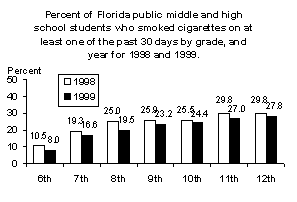
Measuring ProgressWith an annual budget of $4.3 million, the Research and Evaluation component was a fundamental part of Florida’s tobacco control program from the very beginning. The flagship of this effort is the Florida Youth Tobacco Survey, overseen by the University of Miami Coordinating Center. The baseline survey in 1998 included a representative sample of 22,540 middle and high school students in 255 schools across the state. The first follow-up survey included 20,978 students from 242 of the schools that took part in the first survey. The results of the 1999 survey came as a pleasant surprise to program leaders. From 1998 to 1999, the prevalence of current cigarette use among middle school students declined from 18.5% to 15.0% (p<0.01); among high school students, use declined from 27.4% to 25.2% (p=0.02). (Bauer, 1999) Although Florida’s results could not be immediately compared to national figures, the CDC noted that the decline in smoking prevalence among youth was the largest seen in a single year since 1980. (Bauer, 1999) (See Appendix A for prevalence results by sex, race/ethnicity and grade for 1998 and 1999.)In between the statewide annual surveys, evaluators performed dozens of focus groups and smaller surveys to track progress in specific groups and to measure the impact of components of the program on knowledge, attitudes and beliefs. For example, the Florida Anti-Tobacco Media Evaluation (FAME) performed by Florida State University specifically examined the effects of the program’s $25 million dollar Marketing and Communications component. Within 6 months, more than 9 out of 10 teens in Florida were aware of the campaign. (Florida Department of Health, 2/4/99) “Truth”The most prominent component of the program was its $25 million anti-tobacco advertising campaign. The private advertising firms hired to produce media spots quickly learned that youth were already aware that smoking is unhealthy and they would tune out a health-based campaign. Jared Perez, who was SWAT’s 18-year-old SWAT marketing director, said they had to try a different approach, “So instead of saying smoking’s bad for you, which everybody knows anyways, it’s kinda beating a dead horse, we say, ‘the tobacco industry has lied to you, it’s manipulated you, it’s using you, and now that you know that, do you still want to smoke, do you want to be a pawn and pay with your life and your pocketbook?” (Jared Perez, personal communication, 2/16/99)Youth responded to the “Truth” campaign’s anti-industry thrust (Florida Department of Health, 2/4/99), but the frequent lampooning of middle-age business executives did not go over as well with Republican leaders of the state House. And ConsequencesThe late Democratic Gov. Chiles had intended the program to be a legacy of his administration. As the then-Acting director of the program put it, “He was willing to fight for this program, whatever it took. In the last hours of the legislature, when the Speaker, the President and the Governor make up their lists of the five or six things they gotta have, this was on the list for Governor Chiles.” (Peter Mitchell, personal communication, 3/31/99) However, the significance of the governor’s commitment also revealed a weakness in the political underpinnings of the program. After Gov. Chiles died just before he was due to leave office, the tobacco program was left without a strong champion.The new Republican governor, Jeb Bush, moved the program out of the governor’s office and placed it under his Secretary of Health. Although Gov. Bush asked the 1999 legislature to appropriate $61.5 million for the second year of the tobacco program, critics considered his support to be tepid. When House leaders threatened to kill the program, Gov. Bush’s staff said he favored the program, but he did not wage a public battle to save it. (Kennedy, 3/24/1999) The Bush administration also forced out Peter Mitchell, the outspoken Acting Director of the program. The Florida Secretary of Health said he just wanted to take the program in a new direction, but Mitchell said that he was being sacrificed to appease the program’s opponents in the legislature. (Peter Mitchell, personal communication, 3/31/99) Newspaper editorials from around the state came to the program’s defense, and polls by supporters indicated four out of five Florida voters wanted funding held stable, or even increased. (Campaign for Tobacco Free Kids, 4/6/99) But other allies, such as the Florida chapters of the American Cancer Society, American Heart Association and American Lung Association declined to criticize legislators. (Givel, 1999; William Novelli, personal communication, May 26, 1999) Ultimately, the program survived, but funding declined from $70 million to less than $39 million. Eleven of 31 staffers were laid off, including three of the most outspoken SWAT youth staff. Just before leaving her post, program spokeswoman Carlea Bauman expressed doubts about the future of the program. “I’m concerned at this point, because I haven’t seen much there to reassure me that there are people who understand this fight against the tobacco industry. (Clark, 6/3/1999) After blazing out of the starting blocks, the Florida Tobacco Pilot Program seemed to go into hibernation as it entered its second year. News on the program’s website has not been updated since May 1999. Anti-tobacco advocates warn the program has turned dull. (Kennedy, 10/30/1999) ConclusionsThe Florida Tobacco Pilot Program had solid public health science on its side, but good science isn’t enough. As the director of the Evaluation component, Dr. Ed Trapido noted, “I can talk about research, I can’t talk about, I don’t know how to talk yet to politicians, and necessarily be effective. I’m just learning that. That’s not what they teach you in programs of epidemiology.” (personal communication, 3/29/99)The problem is not just that tobacco lobbyists have deep pockets; although the tobacco industry made nearly $400,000 dollars in contributions to legislators and state political parties during 1997 and 1998. (Givel, 1999) Anti-tobacco advocates and other observers say the political hazards in Florida were more subtle, that the brash, youth-oriented campaign alienated conservative legislators who were already skeptical of government efforts to change individual behavior. (Peter Mitchell, personal communication, 3/31/1999; John Kennedy, personal communication, 4/1/1999) In order to achieve their goals, public health advocates need to do a better job of navigating political channels. To say tobacco is the leading preventable cause of death is correct, but insufficient. Both the goals and methods of public health programs, especially controversial ones such as tobacco control, must be presented persuasively to political and voters who may have other priorities. One such approach is an appeal to the logic and fairness of dedicating revenues from tobacco taxes and legal settlement funds to the health care needs of smokers, smoking cessation programs, and the prevention of smoking among underage youth. Organizations that support public health goals should use the reservoir of public goodwill they enjoy to pursue ballot initiatives, such as those that created tobacco control programs in Oregon and California. It is generally harder for legislators to openly repeal a vote of the people, than it is to move appropriations around in a committee room. Above all, public health advocates must realize that they must work just as hard at building alliances and appealing to public opinion as they do at devising solid research designs and working through peer review. Unlike cell culture studies, public health is not performed in a laboratory, but on the larger stage of politics, money and social attitudes. Specific Disclaimers:Even though Florida boasted a dramatic decrease in smoking prevalence among youth in the first year of the Tobacco Pilot Program, questions about the actual effectiveness of the program remain. National figures that can be directly compared to the results of the Florida Youth Tobacco Survey are needed, in order to see if what happened in the state was truly exceptional, or just part of a larger trend. (Jeff McKenna, CDC, personal communication, 3/21/99) Although focus groups and other instruments indicate that the program did affect knowledge, attitudes and beliefs of youth, the effects on prevalence of price hikes during the study period has not been directly assessed. (Bauer, 1999) Just as some uncertainty remains about the effectiveness of the first year of the program, if progress stalls during the second year, it may be difficult to assign blame to program cuts and changes made by the 1999 legislature and the new program managers.In addition, the viewpoints of program critics cannot be simply dismissed as wrong-headed, for they raise fundamental issues of autonomy and the relative roles of individuals, business and government. There is no doubt that reduce tobacco use would reduce tobacco-related illness and death, but anti-tobacco advocates must make a convincing case for the manner in which they seek to interfere with self-destructive behavior. The Florida program focused on youth who are too young to legally smoke cigarettes, but the critics main complaint was the vilification of tobacco industry executives, who contend that they market their products to adults only. The Florida Tobacco Pilot Program experience raises issues of science, politics, advocacy and ethics; in other words it is an example of the practice of public health in all its dimensions. Appendix A: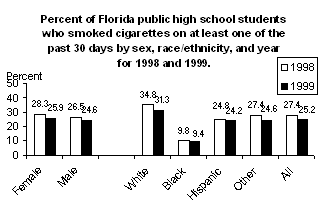
source: 1999 Florida Youth Tobacco Survey, Supplement to Volume 2, Report 1, March 23, 1999 References:
Campaign for Tobacco Free Kids press release, April 4, 1999. Retrieved on April 7, 1999 from http://www.tobaccofreekids.org/html/releases.cfm?id=204 Centers for Disease control and Prevention, Office of Smoking and Health. Tobacco Use – United States, 1900-1999. MMWR. 48(43). 986-994. Centers for Disease Control and Prevention. Decline in Cigarette Consumption Following Implementation of a Comprehensive Tobacco Prevention and Education Program - Oregon, 1996–1998. MMWR. February 26, 1999. 48 (7):140-3 Clark, L. Anti-tobacco ad staff cut, alarming activists in The Miami Herald. June 3, 1999. FDA Commissioner David A. Kessler, as quoted in an FDA press release on August 23, 1996. Retrieved on December 8, 1999 from http://www.os.dhhs.gov/news/press/1996pres/960823a.html Florida Department of Health, Department of Business and Professional Regulation, Florida Tobacco Pilot Program Progress Report, Second Quarter Fiscal Year 1998-99, February 4, 1999 Florida Department of Health, Department of Business and Professional Regulation, Florida Tobacco Pilot Program Progress Report, Fiscal Year 1997-98 & First Quarter Fiscal Year 1998-99, September 28, 1998 Flynn BS, Worden JK, Secker-Walker RH, Badger GJ, Geller BM, Costanza MC (1992). Prevention of cigarette smoking through mass media intervention and school programs. American Journal of Public Health, 82, 827-834. Flynn BS, Worden JK, Secker-Walker RH, Pirie PL, Badger GJ, Carpenter JH, Geller BM, (1994). Mass media and school interventions for cigarette smoking prevention; effects two years after completion. American Journal of Public Health, 84,1148-1150. Givel, MS; Glantz, SA. Tobacco Industry Political Power and Influence in Florida From 1979 to 1999. Institute for Health Policy Studies, School of Medicine, University of California, San Francisco. San Francisco CA 94143-0936. May 1999 Kennedy, J. Critics say state sends wrong smoking signals, in The Orlando Sentinel, October 30, 1999. Kennedy, J. Is governor blowing smoke on 'Truth?' in The Orlando Sentinel, March 24, 1999. Mcginnis, J; Foege, W. Actual causes of death in the United States. JAMA. 270. November 10, 1993. 2207-2212 |
|
||
| Home * House MD * E-mail * Bio * Resume |

Dr. House in Deutschland
